Create Account
Japan’s Martian Moon Mission: How Robots Could Unlock the Secrets of Phobos and Deimos
Mars has fascinated scientists for decades. Robotic rovers have explored its surface, orbiters have mapped its terrain, and landers have investigated its atmosphere and soil. Yet two small worlds traveling alongside the Red Planet remain among the most mysterious objects in the Martian system.
They are Phobos and Deimos, Mars’s two moons.
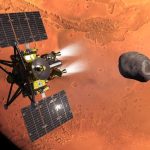
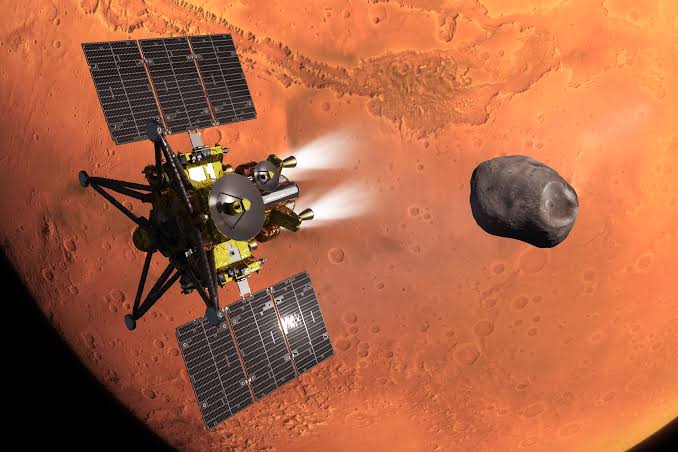
Now, Japan’s Martian Moons eXploration mission, known as MMX, is preparing to take planetary exploration a step further. Led by the Japan Aerospace Exploration Agency (JAXA), the mission is designed to study both moons, deploy a robotic rover to Phobos, collect surface material, and return samples to Earth for detailed laboratory analysis.
As of October 19, 2026, JAXA lists the mission’s launch as scheduled for October 20 at 4:41:03 a.m. Japan Standard Time, aboard an H3 rocket from Tanegashima Space Center. The launch has not yet occurred according to the latest official information available for this article. The mission timeline may change if launch conditions or other technical requirements require a delay.
If successful, MMX could help answer a question scientists have debated for decades: did Phobos and Deimos form from material blasted away from Mars during a massive collision, or are they asteroids that Mars captured with its gravity?
The answer could reveal important details about how the Martian system formed, how material moved through the early solar system, and how rocky worlds acquired the ingredients that may support life.
Why Are Mars’s Moons So Mysterious?
Phobos and Deimos are very different from Earth’s Moon. Both are small, irregularly shaped, and covered in impact craters. Phobos is the larger of the pair, while Deimos is smaller and farther from Mars.
Despite the many missions sent to the Red Planet, scientists have limited direct information about the moons’ internal structures and precise compositions. Previous spacecraft observations have revealed their shapes, surfaces, and some of their physical properties, but those observations have not conclusively established how they formed.
Two major explanations remain under investigation.
The first is the captured-asteroid hypothesis. Under this explanation, Phobos and Deimos originally formed elsewhere in the solar system and were later captured by Mars’s gravity. Their dark surfaces and some of their spectral characteristics resemble those of primitive, carbon-rich asteroids, making this possibility scientifically interesting.
The second is the giant-impact hypothesis. It proposes that a large object collided with early Mars, ejecting material into orbit. Some of that debris may eventually have gathered into the two moons.
Each hypothesis predicts different characteristics for the moons’ composition, structure, and formation history. Scientists therefore need more than photographs to distinguish between them.
A spacecraft can map a surface and measure properties remotely, but a physical sample offers a different kind of evidence. By examining grains and minerals with laboratory instruments, researchers can investigate chemical composition, mineral structure, isotopic ratios, and the history recorded in the material.
That is the central promise of MMX: combining detailed spacecraft observations with samples brought back to Earth.
The Spacecraft: A Robotic Laboratory Traveling to Mars
MMX is designed around a demanding sequence of operations. It must travel from Earth to the Martian system, navigate around Mars and its moons, conduct observations, approach the surface of Phobos, collect material, and eventually return a sample capsule to Earth.
The spacecraft includes three major modules: a propulsion module for interplanetary travel and maneuvering, an exploration module for studying the moons and conducting surface operations, and a return module designed to carry the collected material back home.
These systems must work together across millions of kilometers, where communication delays prevent mission controllers from manually directing every movement in real time.
JAXA plans to equip MMX with a suite of scientific instruments for studying the moons’ surface, composition, topography, gravity, and internal structure. The spacecraft will also carry navigation and sampling technologies needed to perform its mission.
One important instrument is TENGOO, a telescopic camera intended to capture detailed images of the moons. These images can help scientists map craters, identify surface features, and assess the geology of potential landing sites.
Another instrument, OROCHI, is designed to observe the moons in multiple visible-light wavelengths. Differences in reflected light can reveal clues about surface materials and help researchers identify areas that deserve closer examination.
The spacecraft will also use the MIRS infrared spectrometer to investigate the moons’ mineral composition. Infrared observations can help distinguish different minerals and identify spectral signatures associated with particular materials.
Meanwhile, LIDAR measures distances using laser pulses. By collecting distance measurements across a surface, the instrument can help construct detailed three-dimensional maps of the terrain.
Together, these instruments allow the spacecraft to study the moons from several scientific perspectives. Images reveal shape and surface features; spectroscopy provides clues about composition; and distance measurements help determine elevation and local terrain.
No single instrument can explain the entire history of a moon. The scientific strength comes from combining the results and checking whether different measurements support the same interpretation.
Robotic Navigation in an Unusual Environment
Reaching Phobos is not simply a matter of pointing a spacecraft toward a visible target. The moon has a weak gravitational field, an irregular shape, and a complex orbital relationship with Mars.
Its low gravity makes surface operations particularly challenging. A spacecraft approaching too quickly could bounce away, disturb loose material, or lose contact with the surface before its sampling equipment has completed its work.
Mission engineers must therefore carefully control the spacecraft’s position, orientation, and velocity.
Navigation begins long before landing. Cameras and other instruments help refine estimates of the moon’s shape, rotation, and position. Scientists use these observations to improve maps and models of the local environment, while flight controllers plan maneuvers that place the spacecraft in suitable observation and sampling trajectories.
As the spacecraft approaches its target, the navigation system must account for the moon’s changing position and the spacecraft’s motion. The landing area must also be evaluated for hazards such as slopes, large rocks, and terrain that could interfere with contact or sample collection.
This is where robotics becomes especially important.
A robot cannot rely on the same environmental cues that guide a human walking across a landscape. It needs sensors, control software, and carefully designed mechanisms to operate within the limits of its surroundings.
MMX will use a quasi-satellite orbit around Phobos for detailed observations. This is not a conventional orbit in the simplest sense; it is a trajectory that allows the spacecraft to remain near the moon while also accounting for the gravitational influence of Mars.
The spacecraft’s ability to navigate, observe, and approach Phobos is itself a major engineering objective. Technologies developed for this mission could inform future robotic missions that need to operate around small moons or other bodies with weak gravity.
Meet IDEFIX: The Small Rover Built for Phobos
One of the mission’s most interesting technologies is IDEFIX, a compact rover developed through cooperation between France’s space agency, CNES, and the German Aerospace Center, DLR.
Unlike a conventional Mars rover, IDEFIX must operate in extremely weak gravity. On Phobos, the rover’s effective weight would be equivalent to only a small fraction of its Earth weight. That creates an unusual challenge for wheels, suspension systems, traction, and movement.
On Earth, a wheeled robot benefits from gravity pressing its wheels against the ground. On Phobos, the rover has far less downward force helping maintain contact with the surface. If its wheels spin or its body moves unexpectedly, it could disturb the ground or lose stable contact.
IDEFIX is designed to investigate how wheeled mobility can work under these conditions.
The rover is expected to help characterize the surface and evaluate the environment before MMX attempts its own sample-collection operations. It will also carry instruments to examine the texture and composition of the terrain.
First, it can improve scientists’ understanding of Phobos itself. Surface texture, grain size, and the way material behaves under low gravity may reveal whether the moon’s outer layer is relatively compact or composed of loose, mobile debris.
Second, it can help mission engineers make better decisions about where and how the main spacecraft should collect samples.
A landing site that looks safe from orbit may behave differently when a robot touches down. Small rocks could shift, surface material could be looser than expected, or a slope could make stable contact more difficult. Direct measurements from IDEFIX can help reduce these uncertainties.
The rover is therefore both a scientific instrument and a technology demonstration. Its work could contribute to future exploration of asteroids, small moons, and other low-gravity environments where ordinary terrestrial assumptions about movement do not apply.
How MMX Will Collect Samples
The most ambitious part of the mission is its attempt to bring Phobos material back to Earth.
JAXA’s plan calls for MMX to collect at least 10 grams of material from Phobos using two sampling operations. The spacecraft is designed to gather material from the surface and place it in a return capsule for the journey home.
Ten grams may sound like a tiny amount, but it can be scientifically valuable. The significance of a sample depends on its composition, representativeness, and the quality of the analyses that researchers can perform.
Sampling requires more than touching the ground. The spacecraft must approach the surface with carefully controlled motion, make contact, acquire material, and secure it without contaminating the sample or losing it in the low-gravity environment.
MMX includes sampling systems intended to gather material during brief surface operations. The mission’s two planned collection opportunities offer a chance to acquire material from more than one location or attempt, improving the opportunity to return a useful scientific sample.
Once collected, the material must be stored and protected throughout the spacecraft’s return journey. The sample capsule will eventually separate from the main spacecraft and enter Earth’s atmosphere, then land for recovery.
JAXA currently targets the sample’s return to Earth in 2031. The schedule depends on the spacecraft successfully completing its launch, cruise, observations, sampling, departure, and return phases.
This is an especially demanding mission because the spacecraft must complete a round trip to the Martian system. It is not simply delivering an instrument to another world; it must bring material back across interplanetary space.
Why Return Samples to Earth?
Robotic spacecraft can carry powerful scientific instruments, but their size, mass, energy requirements, and operating environment place limits on what they can do.
Earth-based laboratories offer a different level of flexibility. Scientists can use large instruments, conduct repeated measurements, compare results across laboratories, and revisit samples as analytical techniques improve.
Researchers could examine Phobos material using electron microscopes, mass spectrometers, mineral-analysis equipment, and other specialized tools. Such studies may reveal the elements and minerals present, the isotopic composition of the material, and whether its history is more consistent with an asteroid origin or a giant impact involving Mars.
The samples may also contain tiny fragments of material ejected from Mars by ancient impacts. If such material is present and can be identified, it could provide an additional way to study the Red Planet’s geological history.
However, researchers will need to distinguish between possible sources carefully. A sample from Phobos is not automatically a direct sample of Mars, and its composition may reflect several processes, including impact events and long exposure to the space environment.
Contamination control will be essential. Material collected by a spacecraft can be affected by terrestrial substances introduced during assembly, handling, or recovery. Scientists therefore need careful documentation and procedures to separate possible contamination from genuine extraterrestrial signatures.
The benefit is that samples can continue to be studied long after the spacecraft’s mission ends. Future researchers may be able to extract information that today’s instruments cannot yet reveal.
What About Deimos?
Although Phobos is the mission’s primary sampling target, Deimos is also an important part of MMX.
After completing its major work around Phobos, the spacecraft is planned to investigate Deimos through additional observations and flybys before leaving the Martian system.
These observations can help scientists compare the two moons’ shapes, surface features, and compositions. If the moons share a similar origin, researchers might expect some similarities in their physical properties. If they formed through different processes, their differences could provide important clues.
Comparing the moons is especially useful because studying Phobos alone may not resolve every question about the history of the Martian system.
Deimos’s orbital and physical characteristics provide additional evidence that can be considered alongside the returned Phobos sample. Together, these observations may help scientists evaluate competing formation theories more effectively than either dataset could alone.
A Mission That Could Shape Future Space Exploration
MMX is designed to answer scientific questions, but its engineering objectives may be equally important for the future of space exploration.
The mission will test technologies for operating around small celestial bodies, navigating in the Martian environment, deploying a rover under weak gravity, collecting material, and returning a sample to Earth.
These capabilities could inform later missions to Mars’s moons and other small bodies. They may also help engineers develop better strategies for autonomous exploration when communication delays make continuous human control impractical.
A reliable sample-return system is particularly valuable because it demonstrates how a mission can travel to another planetary system, acquire material, and deliver it to researchers on Earth. That is a more complex task than performing a one-way flyby or leaving a stationary lander behind.
The international partnership also demonstrates how modern planetary exploration relies on shared expertise. JAXA leads the mission, with contributions from NASA, CNES, DLR, and the European Space Agency. Different organizations bring experience in scientific instruments, rover development, mission operations, and deep-space exploration.
The journey is a reminder that some of the biggest questions in space science can begin with the smallest samples—and that a carefully designed robot can carry those questions all the way back to Earth.
References
- JAXA — Martian Moons eXploration (MMX): Official Mission Website and Launch Status
- JAXA — MMX Mission Overview and Mission Flow
- JAXA — Official H3 Rocket Flight No. 10 Launch Time Announcement
- European Space Agency — Mars Moon Lander Set to Launch on 19 October
- German Aerospace Center (DLR) — MMX Mission and IDEFIX Rover Ready for Launch
- Space.com — Inside the Science of Japan’s Bold MMX Mission to Mars