Create Account
What if artificial intelligence could help scientists search for clues about the universe hidden inside billions of particle collisions?
That possibility is moving closer to reality. On October 15, 2026, CERN, the European laboratory behind the Large Hadron Collider, announced a strategic partnership with French AI company Mistral AI to develop a new type of artificial intelligence designed specifically for scientific discovery.
The project, known as Flare, aims to create a large physics model trained on billions of simulated particle collisions. Rather than learning primarily from books, websites, and conversations like conventional language models, the system will learn from the complex patterns produced when particles collide at enormous energies.
The goal is ambitious: help physicists process experimental data, identify particles, reconstruct collision events, and recognize unusual signals that may deserve closer investigation.
This does not mean machines will independently solve the mysteries of the universe. Instead, AI could give researchers more powerful tools for examining data that would be extraordinarily difficult to analyze using conventional methods alone.
To understand why this matters, it helps to look at how particle physics works, why the data challenge is so enormous, and what AI might contribute to the search for new scientific discoveries.
1. The Large Hadron Collider Creates an Extraordinary Data Challenge
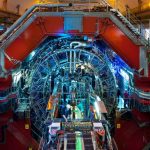
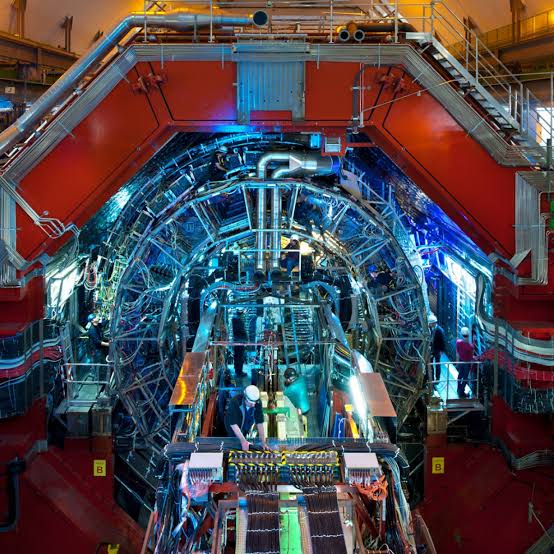
The Large Hadron Collider, or LHC, is the world’s largest and most powerful particle accelerator. Operated by CERN near the French-Swiss border, it accelerates beams of protons to extremely high energies and brings them into collision.
These collisions recreate conditions that allow scientists to study fundamental particles and the forces governing their interactions. By examining what emerges from a collision, researchers can test existing theories and investigate questions about the fundamental structure of matter.
But a collision does not produce a simple picture with neatly labeled particles.
Instead, it can generate a complicated cascade of particles that travel through sophisticated detectors. Different detector components measure different properties, including particle tracks, energy deposits, and timing information.
Scientists must combine these measurements to reconstruct what happened.
This process becomes especially challenging when many collisions occur close together. Multiple interactions can overlap in the same detector readout, making it difficult to distinguish which signals belong to which particles.
The volume of information is also immense. CERN reported in October 2026 that it stores approximately one exabyte of experimental LHC data—equivalent to roughly one million terabytes. The planned High-Luminosity LHC upgrade, expected to begin operating around 2030, is projected to increase the number of collisions tenfold.
For researchers, the challenge is not simply storing more information. It is turning that information into reliable scientific evidence.
AI could help by learning complex patterns in detector measurements and assisting with several stages of the reconstruction process.
2. How AI Learns From Simulated Particle Collisions
One of the most important features of the CERN–Mistral partnership is its emphasis on simulated data.
Before scientists can confidently interpret real experimental measurements, they need ways to predict what different physical processes should look like inside a detector.
Researchers use computer simulations to model particle collisions, the particles produced by those collisions, and their interactions with detector materials. The simulations generate data resembling the measurements that an actual experiment would record.
Because the simulated events are generated from a known setup, researchers can often compare the model’s predictions with information about what occurred in the simulation.
That provides a training opportunity.
An AI model can examine large numbers of simulated events and learn relationships between detector signals and the particles that may have produced them. It can then be evaluated on examples it has not seen during training.
The basic process resembles teaching a computer to recognize objects in photographs, but the scientific task is more complex. The model must learn from structured detector information, physical relationships, and complicated patterns that may involve thousands of measurements.
The advantage is that simulated events provide a controlled environment for training and testing.
However, simulation is not identical to reality. Detector conditions, calibration, background processes, and imperfections in physical models can create differences between simulated and real data. Scientists must therefore test and validate AI systems against actual experimental measurements and established physics methods.
A model that performs well on simulated collisions is a promising research tool—not automatic proof that its conclusions about the real universe are correct.
3. From Detector Signals to Reconstructed Particles
One of the clearest potential applications for AI is particle reconstruction.
Imagine that a collision produces several particles, which travel through a detector and leave behind a collection of signals. Researchers need to determine which signals belong together and what particles most likely created them.
Traditional reconstruction methods often use a sequence of specialized algorithms. One stage may identify tracks, another may estimate energy, and another may combine information from different detector systems.
Each stage solves part of the problem, but the entire process can involve many interconnected decisions.
A model trained across multiple stages could potentially learn relationships that are difficult to capture using separate, hand-designed rules.
CERN’s CMS experiment demonstrated the potential of this approach in research published in February 2026. Its machine-learning-based particle-flow algorithm matched traditional reconstruction performance and, in some cases, improved it. For certain top-quark events, the collaboration reported improvements of approximately 10–20% in the precision of jet reconstruction across key particle-momentum ranges.
The new method could also reconstruct events more efficiently using modern graphics processing units.
These results do not establish that every AI model will outperform existing algorithms. They do show that machine learning can make meaningful contributions to a demanding scientific task.
The Flare initiative aims to build on this direction by developing a broader model capable of supporting multiple collider-physics applications.
If successful, such a system could help researchers reconstruct complex events while reducing the need to develop a separate AI model for every individual task.
4. Could AI Find Patterns Humans Miss?
Particle physics is partly a search for patterns that distinguish one physical process from another.
Scientists may investigate a predicted particle by looking for particular combinations of energies, trajectories, decay products, and other measurable properties. The challenge is that interesting events can be buried among enormous numbers of ordinary interactions.
AI can help by learning statistical relationships across large datasets and identifying events that deserve further examination.
For example, researchers might train a model to distinguish a simulated signal associated with a particular process from more common background events. When the model encounters new data, it could rank events according to how closely their characteristics match the learned patterns.
Another approach is anomaly detection. Rather than training exclusively to recognize a specific signal, researchers can investigate methods designed to identify events that differ from the patterns commonly observed.
Such tools could help physicists investigate unusual combinations of measurements or unexpected correlations.
But there is an important distinction between identifying something unusual and discovering new physics.
An unusual event could result from detector noise, a calibration problem, an imperfect simulation, or a statistical fluctuation. An AI system may also identify patterns that appear meaningful in its training data but do not generalize to new measurements.
Researchers must examine these possibilities before claiming a discovery.
AI is therefore best understood as a tool that can help prioritize scientific questions. It may point researchers toward an intriguing pattern, but the pattern must still survive careful testing, statistical analysis, independent checks, and comparison with physical theories.
5. What Could This Mean for the Search for New Physics?
The Standard Model of particle physics explains many known elementary particles and their interactions. It has been tested extensively, but scientists know that it does not answer every fundamental question.
Researchers continue investigating topics such as dark matter, the matter-antimatter imbalance, and the possibility of physical phenomena not explained by current theories.
The LHC contributes to this work by allowing scientists to study high-energy collisions and compare experimental results with theoretical predictions.
AI could help by making some parts of the search more efficient.
A model might help reconstruct complicated collision events, identify subtle correlations, or select promising events from large datasets. These capabilities could allow researchers to spend more time investigating candidate signals rather than manually examining less informative data.
In principle, better reconstruction and pattern recognition could improve sensitivity to certain physical processes.
However, AI does not automatically reveal new particles or explain unresolved mysteries. A model’s ability to classify events depends on the quality of its training data, the physical processes it can represent, and the reliability of its predictions.
There is also a risk of overlooking phenomena that differ substantially from the examples used during training.
For that reason, physicists may need complementary strategies that combine established algorithms, theory-driven searches, statistical techniques, and machine-learning approaches that do not assume a particular new signal in advance.
The scientific value of AI will depend not only on how quickly it processes data, but also on whether it helps researchers ask better questions and test competing explanations more effectively.
6. Why a Large Physics Model Is Different From a Chatbot
The term foundation model is usually associated with AI systems that learn broad patterns from enormous datasets and can then be adapted to multiple tasks.
Language models learn relationships in text. Image models may learn representations from pictures. A physics foundation model is intended to learn useful representations of scientific data and the physical processes those measurements reflect.
Flare is designed around collider physics rather than ordinary language generation.
Its training data will consist of simulated proton-proton collisions, and its intended applications include reconstructing collisions, identifying particles, flagging unexpected signals, and evaluating potential detector designs.
The goal is to build a model that can support several connected tasks rather than relying entirely on a chain of narrowly specialized algorithms.
That approach could have advantages if the model learns relationships that transfer from one task to another. For instance, a better representation of detector signals might benefit both particle identification and event reconstruction.
Yet a larger model is not automatically a better scientific model. Its usefulness will depend on the quality of the data, the physical constraints incorporated into the work, computational requirements, and how accurately it performs on real experimental conditions.
Unlike a chatbot that can produce a plausible-sounding explanation, a scientific model must be judged by measurable performance, reproducibility, and agreement with evidence.
Its outputs need to be tested against established benchmarks, and researchers must understand the limits of its predictions.
7. The Role of Human Scientists Remains Essential
The arrival of AI in particle physics raises an important question: could machines eventually replace parts of the work traditionally performed by physicists?
A more realistic expectation is that AI will change how scientists allocate their time.
Machines are particularly useful for processing large numbers of examples, learning statistical relationships, and applying the same computational procedure repeatedly. Human researchers contribute theoretical understanding, experimental judgment, creativity, and the ability to question the assumptions behind an analysis.
A model might identify a strange pattern, for example, but a physicist must determine whether that pattern has a meaningful physical interpretation.
Researchers must also consider how the model was trained, whether its performance changes across different conditions, and whether an apparent discovery can be reproduced independently.
This is especially important when AI systems are trained on simulated events. A model may learn details of the simulation that do not accurately reflect the real detector, creating an apparent advantage that disappears when applied to experimental data.
Careful validation is therefore essential.
The strongest approach is likely to combine AI’s ability to analyze enormous datasets with scientific methods designed to challenge, verify, and explain its conclusions.
The machine can help find a clue. Scientists must establish what the clue actually means.
8. A Partnership With Potential Beyond Particle Physics
CERN and Mistral AI have described their collaboration as a long-term effort, with high-energy physics serving as the initial focus.
The partnership brings together CERN’s expertise in fundamental physics, experimental data, and large-scale scientific computing with Mistral’s experience developing large AI models.
The immediate ambition is to create a foundation model that can serve multiple collider-physics applications. The broader potential is to develop approaches that could eventually support other scientific disciplines.
Many areas of research face similar challenges: enormous datasets, complicated measurements, expensive simulations, and patterns that are difficult to identify using traditional methods alone.
Some methods developed for particle physics may prove useful in fields where researchers must reconstruct complex observations, model physical systems, or identify unusual events.
However, transferring a model from one scientific domain to another is not as simple as changing its label. Each discipline has its own data structures, physical assumptions, validation requirements, and standards of evidence.
The broader impact of the partnership will depend on what the researchers demonstrate in practice, how the tools are shared, and whether other scientists can reproduce and extend the results.
For now, the focus remains on creating AI that can help particle physicists work more effectively with the extraordinary volume of information produced by the LHC.
What Comes Next for AI and the Search for Answers?
The CERN–Mistral partnership represents a significant step in the effort to develop AI specifically for scientific discovery.
Its Flare initiative aims to use billions of simulated collisions to train a model capable of supporting multiple stages of collider-physics analysis. If successful, it could help scientists reconstruct events, identify particles, investigate unexpected signals, and explore future detector designs.
The project also highlights an important distinction between AI hype and scientific progress.
The exciting possibility is not that a machine will suddenly reveal every secret of the universe. It is that researchers may gain new ways to examine data at a scale and complexity that would otherwise make some analyses more difficult.
That could improve the efficiency of existing research and help scientists investigate questions that demand increasingly sophisticated computational methods.
There are still major challenges, including simulation accuracy, computational costs, generalization to real data, and the need for rigorous validation. The partnership has announced its ambitions, but the full scientific impact will depend on the model’s demonstrated results.
For StevenReport readers, the bigger story is the growing relationship between artificial intelligence and fundamental science. AI is becoming more than a tool for writing, searching, or generating images. It is increasingly being explored as a way to help researchers understand complex systems and extract meaningful information from enormous datasets.
The universe will not give up its secrets simply because scientists build a larger model.
But if AI helps researchers recognize a pattern they might otherwise miss, test a theory more efficiently, or investigate an unusual collision with greater precision, it could become an important part of the scientific process.
And that may be one of the most interesting frontiers in artificial intelligence: not machines replacing scientific curiosity, but machines helping humanity pursue it.
References
- StevenReport.com — Science, Technology, and AI
- CERN — CERN and Mistral Join Forces to Accelerate AI for Science
- CERN — Machine Learning to Reveal More About LHC Particle Collisions
- CERN Open Data Portal — About the Data
- CERN — Artificial Intelligence Programme
- CERN Open Data Portal — ATLAS Higgs Boson Machine Learning Challenge Dataset
- Reuters — CERN and Mistral Partner to Build an AI Model for Physics