Create Account
Humanoid robots have long existed in the realm of science fiction, portrayed as intelligent machines capable of working, thinking, and even coexisting with humans. In recent years, however, rapid advances in artificial intelligence, robotics, and automation have moved these ideas closer to reality. One of the most significant developments in this field is Optimus, the humanoid robot developed by Tesla. Optimus represents a major leap forward in robotics, combining AI-driven intelligence with human-like physical capabilities, and it has the potential to transform industries, economies, and everyday life.
Tesla first introduced Optimus, initially known as Tesla Bot, as part of its broader vision to accelerate technological progress through artificial intelligence and automation. Unlike traditional industrial robots designed for single, repetitive tasks, Optimus is built to operate in human environments. Standing roughly human-sized, it is designed with arms, legs, hands, and a head, allowing it to navigate spaces built for people rather than machines. This design choice highlights Tesla’s ambition to create a general-purpose robot capable of performing a wide variety of tasks.
One of the most notable technological foundations of Optimus is its integration with Tesla’s advanced AI systems. The robot leverages the same neural networks and computer vision technologies used in Tesla’s self-driving vehicles. Using cameras, sensors, and AI-based perception, Optimus can understand its surroundings, recognize objects, and make decisions in real time. This allows the robot to perform tasks such as picking up objects, sorting items, walking across uneven surfaces, and interacting safely with humans.
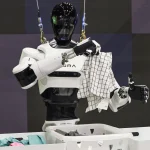
From a science and engineering perspective, Optimus showcases major progress in actuators, balance control, and dexterity. Human movement is complex, requiring precise coordination of muscles and joints. Replicating this mechanically has been one of the biggest challenges in humanoid robotics. Tesla’s engineers have focused heavily on improving Optimus’s walking stability, hand movements, and overall coordination. Recent demonstrations have shown the robot performing tasks like carrying objects, folding clothes, and moving with smoother, more natural motion than earlier prototypes.
The potential applications of Optimus span multiple industries. In manufacturing and logistics, humanoid robots could handle repetitive, physically demanding, or dangerous tasks. Warehouses, factories, and distribution centers often rely on human labor for lifting, sorting, and assembly. Optimus could reduce workplace injuries and improve efficiency by taking on these roles. In healthcare and elder care, humanoid robots may assist with patient support, mobility assistance, and routine tasks, addressing labor shortages in aging societies.
Another key area of impact is household automation. Tesla envisions Optimus eventually performing everyday chores such as cleaning, cooking assistance, and home organization. If successfully commercialized, this could significantly change how people manage their time, freeing individuals from routine tasks and allowing greater focus on creative, educational, or social activities. While this vision is still in development, it reflects a broader trend in science and technology toward intelligent personal assistants that exist beyond digital screens.
Ethical and economic considerations also play an important role in the discussion surrounding humanoid robots. The introduction of machines capable of replacing certain forms of human labor raises concerns about job displacement and economic inequality. However, many experts argue that robots like Optimus will primarily take on tasks that are undesirable, unsafe, or difficult for humans, while also creating new jobs in robot maintenance, programming, and AI development. Managing this transition responsibly will require thoughtful policy-making and workforce reskilling initiatives.
Safety is another critical factor in the development of humanoid robots. Tesla has emphasized that Optimus is designed with safety in mind, including controlled strength, obstacle awareness, and the ability to stop or power down when necessary. Ensuring that humanoid robots can operate safely around humans is essential for public acceptance and large-scale deployment. Advances in sensor technology, real-time monitoring, and AI decision-making are helping address these concerns.
From a broader science and technology development perspective, Optimus represents the convergence of multiple disciplines: robotics, artificial intelligence, materials science, and energy systems. Tesla’s expertise in battery technology also plays a role, as efficient and long-lasting power sources are crucial for mobile robots. Improvements in battery density and energy management directly impact how long humanoid robots can operate without recharging.
While Optimus is still in its early stages, its progress highlights a future where humanoid robots become an integral part of society. Continued research, testing, and refinement will determine how quickly this vision becomes reality. As technology advances, Optimus may serve as a blueprint for future generations of intelligent machines designed to work alongside humans rather than replace them.
In conclusion, Tesla’s Optimus humanoid robot is more than a technological experiment—it is a glimpse into the future of science and innovation. By combining AI intelligence with human-like mobility, Optimus has the potential to reshape industries, improve quality of life, and redefine the relationship between humans and machines. As development continues, the world will be watching closely to see how this ambitious project evolves and how humanoid robots ultimately fit into the fabric of modern society.